As the Garbage Goes

Frosted cinnamon rolls, cinnamon rolls, yeast rolls, frosting,We took a little weekend trip to visit our daughter and son-in-law at their home.  They are apartment dwellers in a city.  It did not take long to see the differences in their lives from our own.

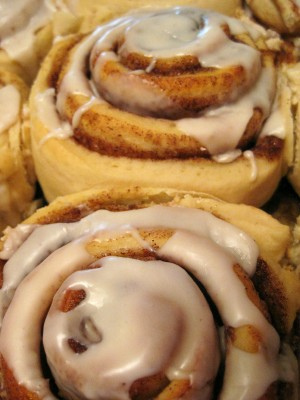
Being a gracious hostess, she served us a lovely breakfast; fruit cups and frosted cinnamon rolls.  I helped her prepare the food.  As the weekend progressed the food kept coming. 

As usual, in meal preparation, waste must be discarded.  Apple peelings, corn shucks, cobs and other produce went in the garbage can.  Steak bones, fat and gristle were destined for the same fate.  Tossing the unwanted trimmings and peelings seemed so foreign to me.

sculpture, sculpted hound, dog, dog bone, dog dish,

Happy Doggie

Our lives on the farm are so different from city life.  We save our fruit and vegetable scraps in a container.  We feed them to the chickens who love it.  Corn shucks and cobs go to the cattle who consume them with delight.  The bones, gristle and fat are saved up for the dog’s evening meal.  There is a lot of use for items on the farm that others toss out.  Lifestyles certainly are not all the same.

Before leaving, we packed up the corn leftovers.   We even packaged up the meat and bone scraps for the dog.  We had a use for all of them.

photo credit: TheSeafarer via photo pin cc
photo credit: clevercupcakes via photo pin cc

Whatever

motorcycle, motorcycle wheel, pencil sketch of motorcycle,

Motorcycle card to be available soon

When I went to visit my family up in my home country of northern Wisconsin, my brother paid me a visitHe drove to the cabin on a motorcycle.

His enthusiasm for his motorcycle was “catchy.”  I had a few photos of it taken.

Back at the farm I have had a little time to put the images on paper.  I know that there are many folks who share an interest in the motorcycle of today.  I thought that they might like a few cards bearing in its likeness.

motorcycle, motor, motorcycle motor, pencil sketch of motorcycle motor,

Motorcycle card to be available soon

Before my Dad died, I heard him say to my brother about his motorcycle riding, “Do it for the Lord.”

The Bible says that to all of us in Colossians 3:17 (NIV), “And whatever you do, whether in word or deed, do it all in the name of the Lord Jesus, giving thanks to God the Father through Him.”
“Whatever” means whatever.  Whatever includes all things, even motocycles.

Aw Shucks!

sweet corn, corn on the cob, shucking sweet corn, shucking, husking, corn husk, husking sweet corn, husking corn, shucking corn,

Shucking Sweet Corn

In the early part of August our sweet corn ripens.  We generally grow 6 rows of it so we will have enough to freeze for the winter.

My husband picked 2 wirebaskets full of ears for us to process yesterday.    I helped him to shuck it.  That means we took the green corn leaves off of the ears.   He brushed the corn to rid it of excess corn silk.

After all the shucking was done, he fed the shucks to the cattle who really enjoyed it.  We, on the other hand, got the ears.

The kitchen preparation included covering the table with several layers of newspaper.  When the kernels are cut off of the ear, the milk of the kernel tends to splash.  Since it is starchy and sweet, it can stick on the surface and be stubborn to wash off.

We plunge the ear corn into boiling water and let it cook for 5 minutes.  That blanches the corn.  From there the ear corn is placed in a dishpan of cold corn-on-the-cob, cooked corn, corn cobs, sweet corn,water to cool until it is easy to handle.  When sufficiently cooled, the corn is cut off of the ear into a pan.  When the tops of the kernels are cut off, then I drag a knife blade from the bottom of the ear to the top*.  In that way the milk of the corn is pressed out and added to the whole kernel.    The milk’s sweetness blends with the tasty kernels and makes a great vegetable for our table.

I package the sweet corn in freezer bags.  We may get to freeze corn on two different days each year.  The rest is used as corn-on-the-cob.  Aw shucks, it’s great!

*NOTE: The bottom to top method prevents milk from from the corn cob from splattering  into my face while I work.  If I scrape the blade from the top to the bottom I get sprinkled in the face and have quite a time with clean up.

photo credit: m+A+s via photo pin cc
photo credit: KitAy via photo pin cc

Peachy Keen!

preserved peaches, canned peaches, canning jars,Preserving peaches has become an annual event in my kitchen.  Since I took up the habit, I barely ever buy the canned ones at the store.  The home-canned peaches taste so much richer and delicious.

When I had children still in my home, I bought 4 lugs of peaches for preserving each year.  That seemed to meet our needs nicely.

A lug weighs about 15-17 pounds.  The number labeling their size (for example, 50) means that there are 50 peaches in the lug.  Smaller peaches labeled 56 would be a smaller peach and 56 of them fit in the lug.  I generally buy the 50s.

The Faye-Elberta variety is my favorite.  Besides being a delicious peach, the stone comes out easily and the peel comes off nicely when scalded.

Equipment to keep on hand includes a water-bath canner, a funnel for filling the jars, mason jars with lids and screw bands and a jar lifter (a clamp that is especially made to lift the jars from the boiling water-bath.)  Ingredients needed are peaches, sugar, water and ascorbic acid crystals I use a product called Fruit Fresh for ascorbic acid.

I also like to make peach pie-filling to keep in my freezer.  It takes Minute tapioca, sugar, peaches, lemon juice, ascorbic acid and salt.   I freeze the filling in freezer bags.  In the winter I put the frozen filling in a  pie pastry and we enjoy the summer’s fruit at short notice.

If you get the chance to try the canning process, the Ball Blue Book has many good recipes to try.  Several of them use peaches.  I recommend this annual event highly.

Back-to-School Sign

While driving in the fields I see sights that I may not notice in the farm yard.

fence, fenceline, fence post, wooden fence post, goldenrod, Along the fence lines plants grow up that are opportunists.  They grow wherever they want.

Goldenrod grows up there all summer long, but seems rather inconspicuous most of the season.  When late July and early August come around, they put up their pale green blooms.  As the time passes, the pale green turns to yellow and then flames to a bright golden color.

barbed wire fence, fence, goldenrod, blooming goldenrod

Nature's Back-to-School Sign

To me, Goldenrod is a bittersweet back-to-school sign.  Summers are special when the kids can be home and help with the work and with the fun on the farm.  When the Goldenrod blooms our minds shift to getting ready to part again; looking forward to a new school year.  Although it has beauty, when I see it I am reminded of the separation ahead.

photo credit: CaptPiper via photo pin cc
photo credit: Bretta Grabau

Filled With Plenty

Hay bales, hay wagon, red barn, silo, cupela

Hay bales travel up the conveyor (or elevator) to the barn.

Stacking the hay in the barn or shed is also important.  We do not want the weather to ruin the dry bales, so they are stored safely where they will be protected from the elements.

The hay shed has a roof and no walls which makes stacking is a bit easier.  At first the bales are tossed off the top of the hay wagon so that the stacker below can get the  pile started.  As the stack gets higher, and closer to the roof, the bales must be lifted up.  Now that is hard work!

hay bales, hay elevator, hay wagonMy husband chooses where he wants the bales stored.  Certain bales are stored in the hay shed.  Some hay is more fit for the barn.  He has to make those decisions.

The hay is stacked floor to ceiling.  In order to get the bales into the barn from the hay wagon, an elevator takes the bale from the wagon to the opening in the barn and drops them inside for my husband to get them and arrange them into solid layers.  The work is hard but it is purposeful and necessary.

Hay bales, Interior of barn,

The barn to be filled with hay

From experience, my husband knows just about how many bales he will need to get the cattle through the winter.  The baler keeps count of how many bales are made in the season.  It is a relief to have this job done in time to face the winter months.

How rewarding it is to know that our barns are filled with plenty.  That gives us another reason to thank the Lord.

Photo credit: Wenda Grabau

A Satisfying Time

After greasing the baler and having a light lunch, my husband gathers up the hay wagons.  We hitch the baler up to the tractor and a wagon behind the baler.

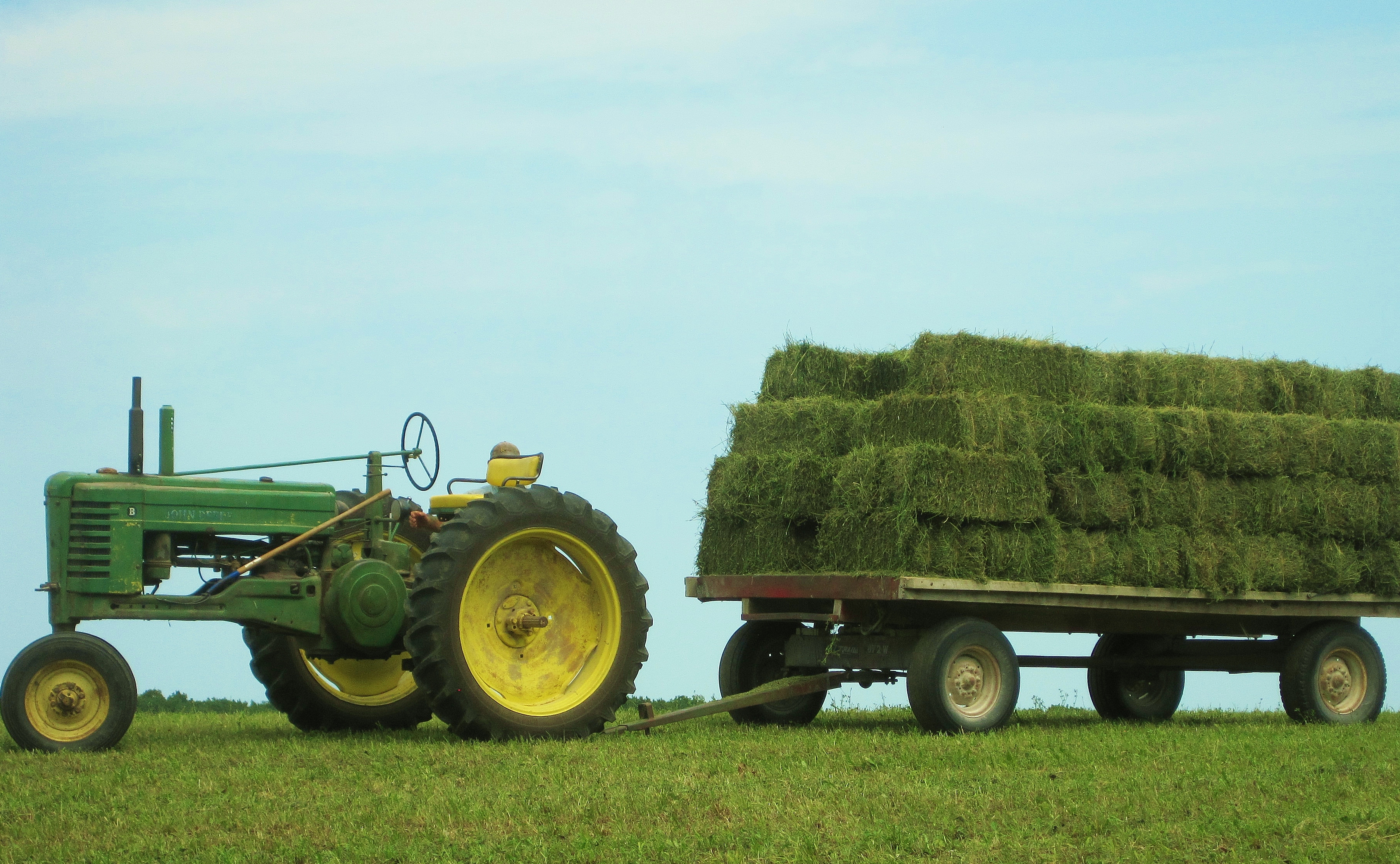
I drive the tractor and baler out to the field.  He drives the John Deere B  with two other hay wagons in tow.   The farm dog, alert with anticipation, waits for his signal from my husband that he may follow.  He darts through the rows of corn to the hay field while we travel the dusty road to our destination.

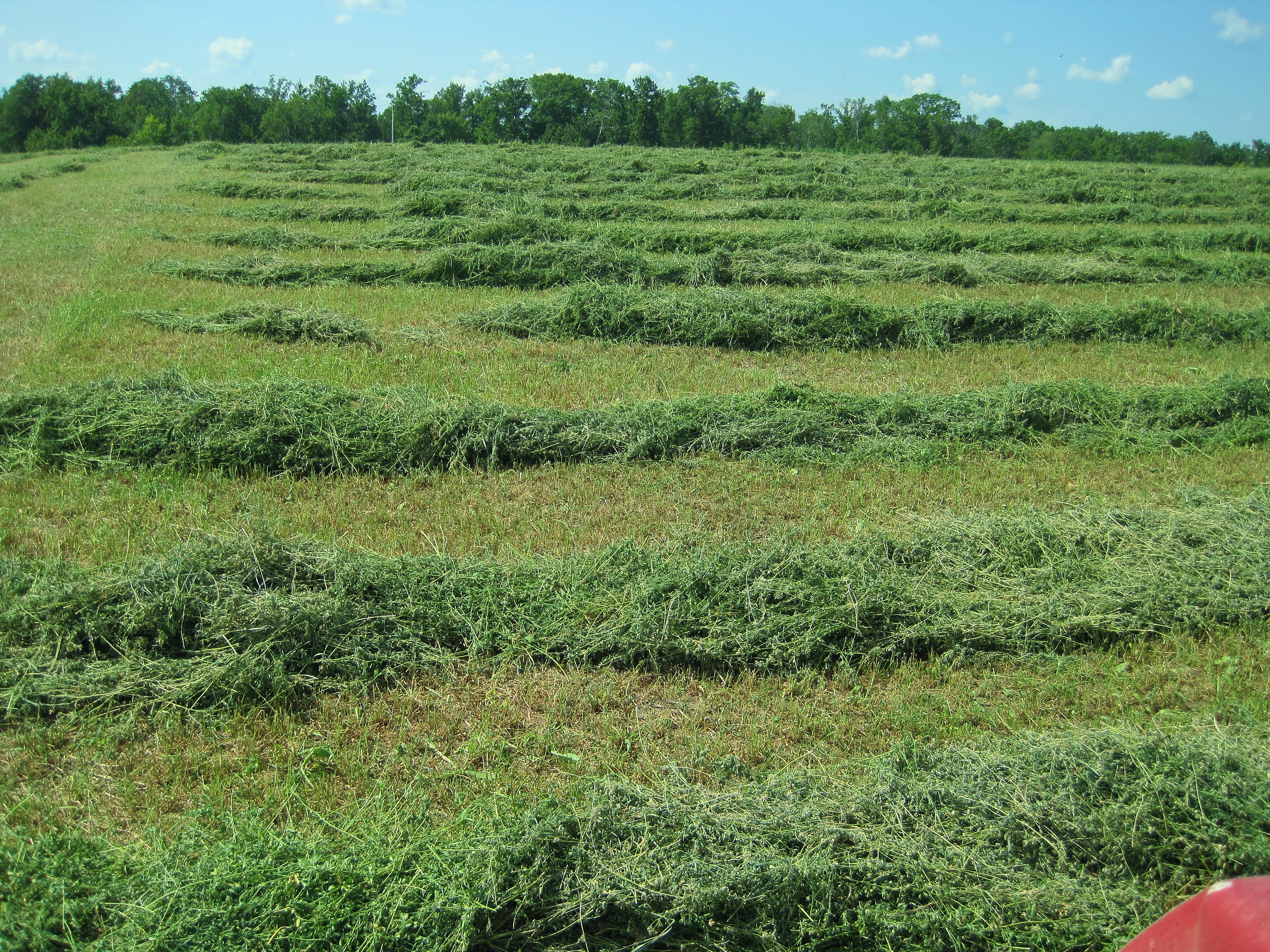
Hay swathe, alfalfa hay, green tractor, farm

Swath of hay resembling a rope of hay before it is baled

My husband parks his tractor and gets the baler ready for action.   He rides the wagon as I drive.  Our baler makes small square bales.   My husband rides the wagon to receive the bales and do the stacking for the first load.

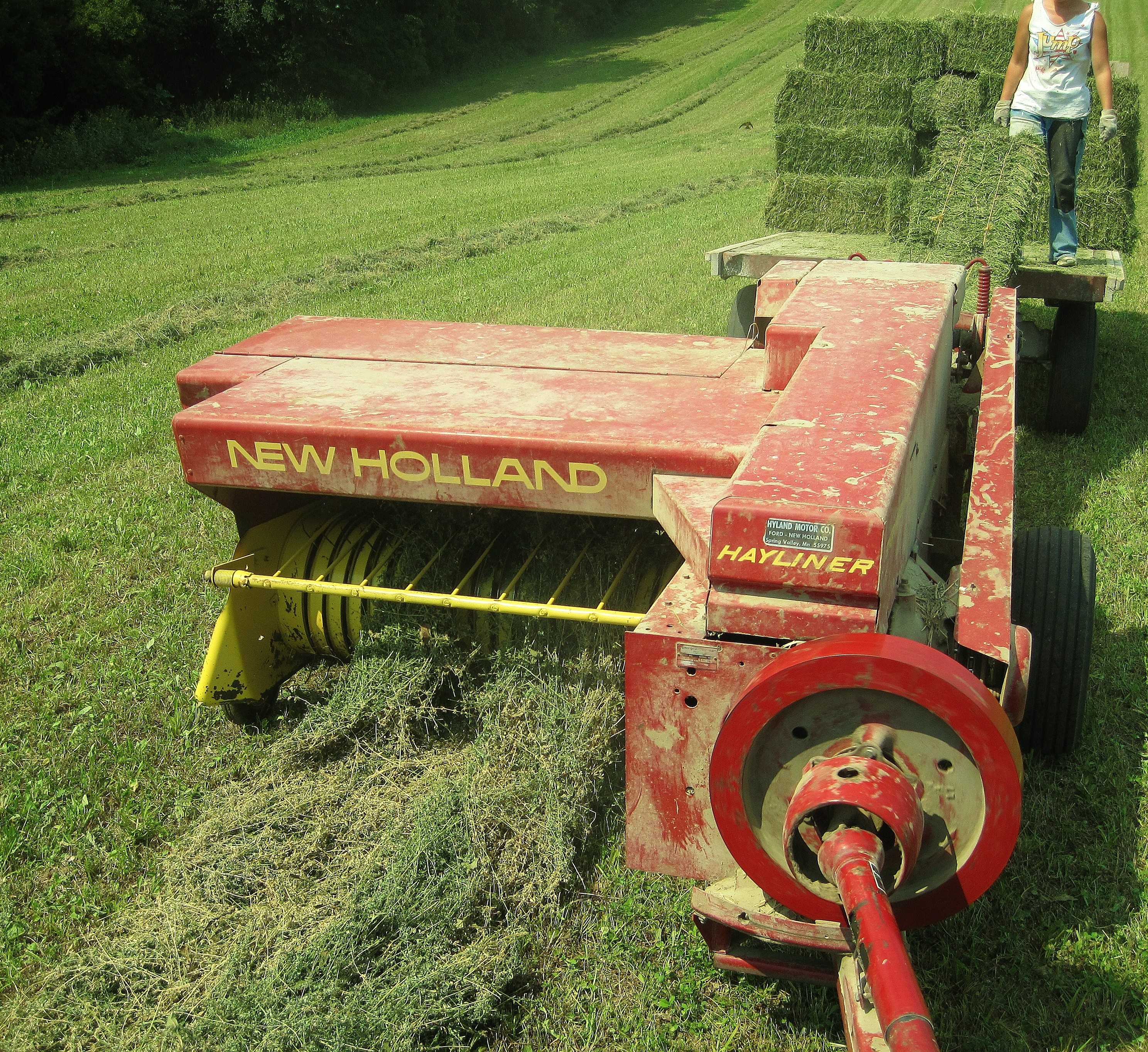
The newly raked hay rows lay ahead resembling a rope.  Baler tines pick up the hay off of the field and forks move the hay into a chamber.  In the chamber, a plunger packs the hay tight into bales.  As it comes out, needles

New Holland baler, hay wagon, hay bales, baling hay

Hay baler at work making square bales

threaded with twine wrap the bales and the knotter ties the twine.  There are tension controls on the twine that we can adjust.  That way we can determine how heavily packed the bale will be.

The bales come out of the baler on a chute that lifts it up to a level that the stacker can grab it and pile it neatly in the wagon.  One wagonload holds roughly 80 bales.  When the first wagon is filled my husband takes it to the farm for unloading in the hay shed or in the barn.

green tractor, hay wagon, hay bales, alfalfa hay

John Deere B and loaded hay wagon

Since haying is a 4-man job at our farm, the second stacker joins me in the field.  Another person is already at the farm ready to unload the wagon, so that my husband can work at stacking them in the sheds or barn.  This has been a team job for our family.  We all get tired out, but haying, in most cases, is a satisfying time of working together.

Photo credit: Wenda Grabau
Photo credit: Bretta Grabau

Risky Business

If humidity levels are normal and the sunshine has been steady for a day or two, then we bale the hay.

hay swathes, alfalfa hay, drying hay, baling hay

Hay Drying in the Sun

After the morning dew has sufficiently evaporated, my husband or I go out and rake the hay.  The haybine has already dropped the hay into neat swaths on the first  pass through the field.  So when I rake, I just have to follow the rows laid out for me.  The rake has a series of tines that rotate into the hay and sweep it to one side.  This action lifts the hay up and rolls it over much like the curl of an ocean wave as it reaches the shore.  This exposes the hay on the underside of the swath to the sun and completes the drying process before we bale it later in the day.

At this stage, if a sudden rainfall catches up with us, the hay is ruined.   Even in making hay there is risk involved.

Hay is important.  If we have good quality hay, we can market more milk and our annual income is better.  If the hay is worthless we use it for bedding or take it off the field so it does not smother the new growth in the field and discard it.  If we have to buy hay, our profit is greatly reduced.

photo credit: Wenda Grabau

The Cutting Edge

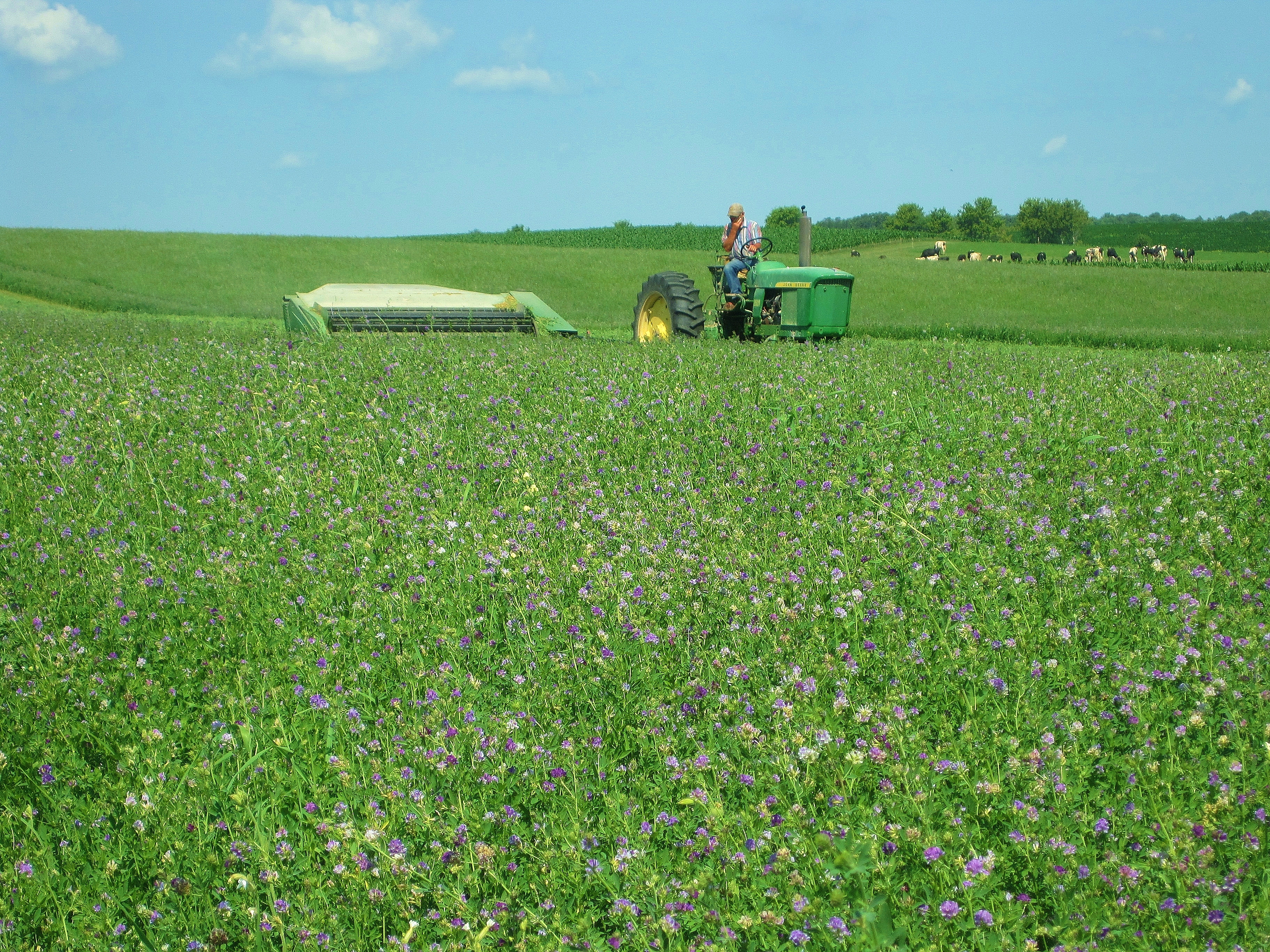
haybine, alfalfa hay, cutting hay, green tractor

Tractor pulls the haybine as it cuts the hay.

When it is determined that the hay is mature enough for cutting, that weather outlook favorable and that the machinery is in readiness, then my husband cuts the hay.

We have small parcels of land that have rolling hills.  So smaller tractors and machinery work well here.  The main machine for haying is the tractor.  Most of the specialized tools we use are powered by it.

In the old days before we farmed here, haying was a bit slower process than ours today.

Before we began our farming careers, farmers would:

  • cut the hay with a cycle mower pulled by a tractor
  • then crimp the hay stalks with a hay conditioner

This way the tractor had to run through the hayfield once for cutting and once for crimping.  The hay-conditioner has rollers in it that crack the hay stems in multiple places.  That speeds up the drying time.

Without the crimping the hay would have to lie in the field a longer time.  This would increase the chance that a change in the weather (rain) could slow the process further and cause decompostion of the hay to start in the field.

Neat Hay swaths made by the Haybine

Hay must be sufficiently dried for storage.  If it is not dried, the moist hay can heat up in the barn so much that fires can start.

Now, we have a tool called the haybine that both cuts and crimps for us on the first pass through the field.  When the weather makes it harder to make the hay in a timely fashion, we cut the hay with the haybine and the next day crimp the hay a second time with our old hay-conditioner.  We use the older technology, too.  It helps our hay to dry a day sooner.

photo credit: Wenda Grabau

Hay There!

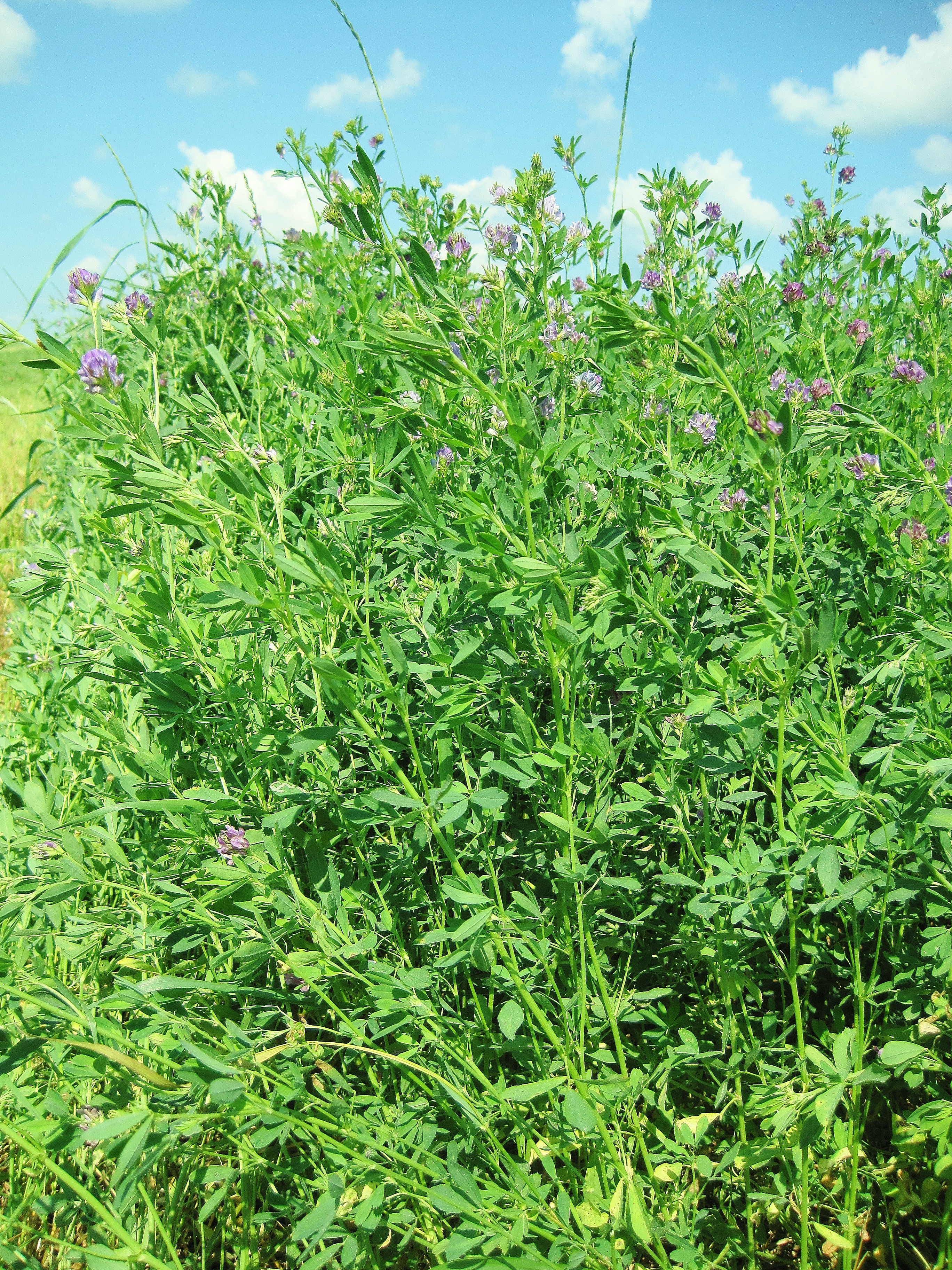
alfalfa, alfalfa hay

Alfalfa Ready for Cutting

Making hay is part of the farmer’s job.

Hay includes:

  • clover
  • grass
  • alfalfa

The high protein value of alfalfa makes it a prime diet for dairy cattle.  Although we are thankful for the grassy hay that comes our way, the alfalfa hay makes for more milk.

Making hay may sound like a simple job, but many variables in cattle, seed, machinery, weather, climate, soil conditions, storage facilities and manpower add to its complexity.

The ideal circumstances are seldom the norm.  So we have to make the best of our hay conditions whatever they are.

In our part of the world, hay grows all summer.  We try to make hay 3 times a year.  Some farmers are able to get 4 or more crops in a season.  Hay is a staple for our animals and warrants a lot of our attention and effort.

photo credit: Wenda Grabau

Page 24 of 32« First...1020«2223242526»30...Last »