Archive - Fresh Off the Farm RSS Feed

A Do-List on the Farm

This morning, before getting on with my day, I read my Bible and spent time thanking the Lord for the world He has provided here for me to live (and work) in.  Before I got started with my chores, I asked the Lord for guidance to know which things He wanted me to attend to for the day.
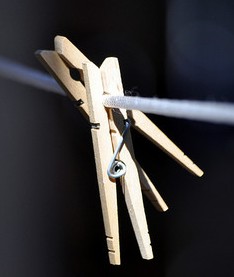
clothesline, clothespins

Luxurious Clothesline

Some of those things included:

  • hanging clothes out to dry  (We have the luxury of a clothesline.)
  • folding laundry
  • dusting my bedroom
  • picking red raspberries (My daughter and I picked 2 gallons today.)
  • fixing steak for lunch
  • planting potato peels (the eyes will grow in spots where my seed potatoes failed to come up)
  • taking a walk for exercise
  • repairing a children’s book my kids used for my grandchildren to use
  • driving tractor to
    green tractor,
    A Must-Have Tool on the Farm

    take a load of hay over to our sister and brother-in-law’s barn for storage.

My day is not over yet.  But you get the idea.   I live in the country and there is plenty to do.

Was I hilariously joyful in all of those jobs?  Not likely.  But I did ask for the Lord’s guidance and I looked for details about the tasks and that I did enjoy. 

Ask for His guidance.  Looking for details can be a treasure hunt that the Lord has in store for you.

photo credit: jasleen_kaur via photo pin cc
photo credit: Lawrence Whittemore via photo pin cc

From the Berry Patch

Red strawberries, strawberry plantWith my strawberries ripening in the patch, I went out to fill up my pan.

I returned with 4 quarts of red, sweet, tasty morsels.

At the urging of my daughter, I used this picking of berries for a simple treat.  Originally it came to us as a beverage syrup from The Settlement Cook Book .  But we also use it on ice cream or on pancakes and waffles.  We call it Strawberry Syrup.

Strawberry Syrup

Gather the Equipment you will need:

  • Potato masher (I don’t like using a blender.  It tends to make the berry mash so fine that the juice will not seep easily through the jelly bag.)
  • Flat pan in which to mash the berries
  • Candy thermometer
  • Several layers of cheesecloth or a jelly bag
  • A canning funnel to aid in a clean pouring of syrup into the jars
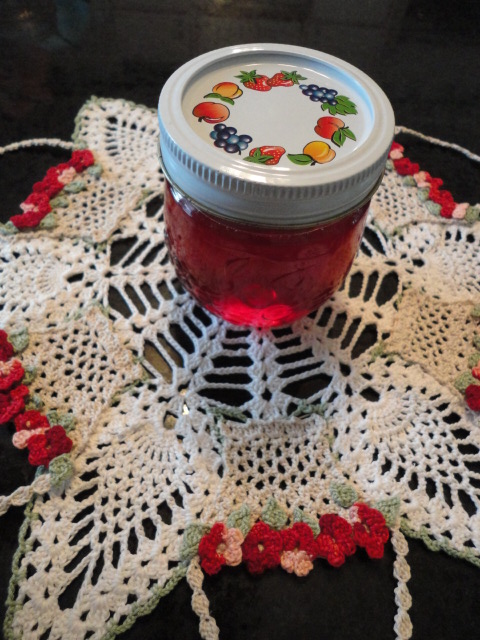
  • 5 or 6 half-pint sterilized canning jars with lids and screw bands 1/2 pint, sealed canning jar; white screwband/fruit ring on lid; white doily, strawberry jelly, jelly

Ingredients:

  • 4 cups mashed berries
  • 4 1/2 cups sugar
  • 2 cups water

Place the mashed berries in a jelly bag to extract the juice.  (You will get approximately 1-1/2 cups of juice.)

Cook sugar and water together until it reaches 234° F.  When it reaches this temperature, add the strawberry juice and bring to a boil again.  Remove from burner.  Skim the top of the syrup.  While still hot, pour the syrup into the sterilized jars and seal with lids and screw bands.

Waffles. strawberry syrup, whipped cream; strawberry garnish, china plate, white yarn place matTwo teaspoons of this syrup mixed in a glass of cold water makes a sweet fruit drink.  It also goes great with waffles and pancakes or it can be used as an ice cream topping.

Note:  We also use this recipe with red raspberries and black raspberries.   It can also be made with currants.
photo credit: bucklava via photo pin cc
photo credit: Deena Hall

Victoria Sauce

rhubarb stalks, red rhubarb

Picture Perfect Rhubarb

Along with asparagus, rhubarb is the other first crop in my garden.

Bulbous blossoms form on the plant which I cut off.  The blossoms will take away from the growth of the leaves which I plan to harvest.  That harvest will last until early to mid-June.

Ceasing to pick the rhubarb for the remainder of the summer will give the rhubarb plants time to recover from the leaves lost in the picking.  It strengthens them for survival till the next harvest.  My rule of thumb is to stop picking the rhubarb when the strawberries are done bearing.

When the leaf stems have reached an appropriate length I pull the whole stem loose from the plant.  I generally have a knife in hand so that I can cut off and discard the huge leaves before returning to my kitchen. The stems measure 10 inches or more when clipped.

I wash and trim the stems, cutting them into 1/2 inch pieces.  I  freeze them in freezer containers to use another day, or I can make jam, or other yummy rhubarb desserts.

One delicacy I make is Victoria Sauce.  I found the recipe in the Ball Blue Book.  It is easy to make and is a delicious sauce for eating with meats.  It compares with sweet-sour bottled sauces that one finds at the grocery store.

Rhubarb-lovers will like this.

                                                Victoria Sauce

2 quarts chopped rhubarb                            1 teaspoon salt

1/2 cup chopped onion                                 1 teaspoon ground cinnamon

1-1/2  cups chopped, seedless raisins         1 teaspoon ground ginger

3-1/2 cups brown sugar, packed                  1 teaspoon ground allspice

1/2 cup vinegar

Combine rhubarb, onion, raisins, sugar and vinegar.  Cook until thick, about 25 minuties.  As mixture thickens, stir frequently to prevent sticking.  Add spices; cook 5 minutes longer.  Pour, boiling hot, into hot Ball Jars, leaving 1/8-inch head space.  Adjust caps. Process 10-15 minutes.  Yield: about 4 pints.
photo credit: sjdunphy via photo pin cc

Hard-Boiled

“Hey, Mom, what’s for lunch?” asks your child.

“Boiled eggs and toast,”  you offer.

“Eeuuu, those green old things,”  he responds with disgust.

Brown eggs, egg carton

Good old farm eggs

Have you ever had such an exchange?  Why do some boiled eggs look white with a greenish yolk?  There is a reason and it can be avoided.

The overcooking of the egg causes the yolks to discolor.

Here is a great way to avoid the “green eggs”.

  • Place the eggs in a kettle. 
  • Add water.  The water level should reach about one-inch above the eggs.
  • Cook to boiling.
  • Turn off the burner and set the kettle of eggs on a cool burner to rest for 15 minutes.
  • Cross-sectioned Hard-boiled eggs
    Golden-yellow Yolks

    Drain off the hot water and cover eggs with cold water. 

  • Peel eggs when cool enough to handle.

The yolks will be a cheerful yellow color.  Try this little trick.  It may revive your relationship to boiled eggs.

photo credit: sassyradish via photo pin cc

photo credit: .::RMT::. via photo pin cc

The Story of Red, the Little Hen: Part 3

He found a cardboard box and loaded it up with some hay for a nest, the eggs, the little chicks and their mother.  He relocated them in the calf shed up the hill from the heifer shed.  Red, the little hen, was content with her new surroundings.

The five chicks are still alive.  The others never did hatch.  So Red happily scratches out food for her five 5 peeping chicks.  She keeps her brood warm in the chilly days and nights.

If a stray cat should venture too close for comfort, she squawks, takes torpedo position and runs straight at them.  The cats get out of the way!!

little chicks, chick facesThe chicks are living the life of Riley.  They have her fluff to warm them, she guides them to the grain and water they need.  They even drink milk out of the cat’s dish!  They have everything that a little chick could want.

Farmer does not have to warm them with brooder lights nor does he have to fence out the critters that might harm the peepers.  Their mother watches over them.

The little critters are starting to lose their baby fluff and to develop true feathers on their wings and tails.  How fun it is to witness the development of one of God’s creatures as they move into adulthood.

That ends the story-telling for today.  Just remember that tragic events, as in the life of Red, the little hen, can lead to new, dynamic, changes in life that bring new joys and responsibilities.

The Story of Red, the Little Hen: Part 2

As the chill of autumn descended on Heritage Farm, Farmer, Farmer’s Wife, and Little Sister, their youngest child, set about to move bales of hay out of the heifer shed in order to get it ready to house heifers over the winter.  They loaded  hay bales onto the hay wagon and piled them high.  They were preparing to bring them into a nearby hay shed.

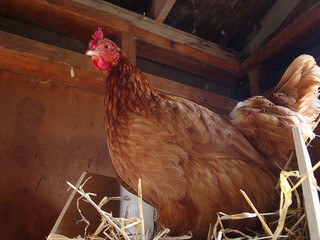
Red hen in straw in hay mow

Red's stubborn perch

While busy working and moving hay bales, Farmer noticed Red, the little hen, in a corner, sitting on a bale of hay.  Generally, hens will move whenever disturbed.  Curiously, Red would not budge.  Farmer had to move her.  He was not about to let one little hen alter his plans for the day.  He could not work around her, she would have to be moved.  He picked her up and to his surprise, he found a clutch of a dozen eggs and 5 live chicks beneath her!!

photo credit: mazaletel via photo pin cc

The Story of Red, the Little Hen: Part 1

Samson, the dog, heard a ruckus in the hen house one evening as the summer sun rested on the horizon.  He burst in to find a racoon beating up on a hen.  Her head was bloody and messed up.  Samson, the faithful, white German Shepherd, got the ’coon.   He certainly will not be a bother there again.

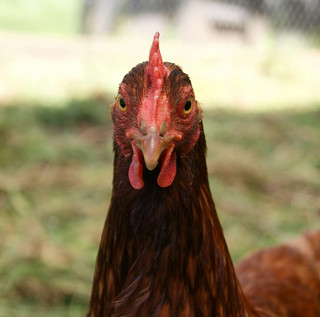
Red hen face

Red stayed away from the hen house.

The hen proceeded to run outside and never dared return to the hen house.  She recovered from her wounds, but the fear of the chicken coop would not heal.  Regardless of the possible dangers of the night, she risked spending them anywhere but in that little shed.

Farmer watched her progress since that terrible incident that summer.  She did not bother him and he did not bother her.  Each went about their own business.
photo credit: HA! Designs – Artbyheather via photo pin cc

The Trick to Picking Asparagus

One of the first two crops in my garden is asparagus.  Many folks consider this a delicacy.  I suppose it is, but it comes each spring and is regular fare on our table at this time of year.

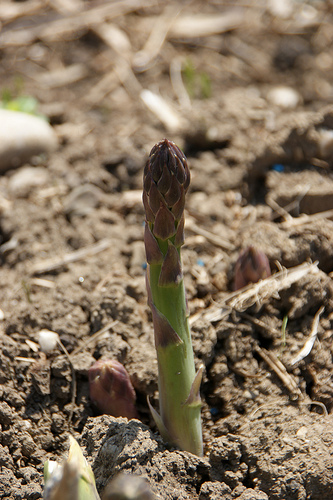
Single asparagus shoot emerging from ground

A sprout ready for picking

We have had several good rains recently, so the crop has grown.  After sorting out the woody parts of the young sprouts, I got 2 pounds of asparagus.  That will make 2 batches of soup and a side dish for tonight’s supper.

Asparagus’ nutrients are mainly in the tips of the sprout.  Therefore a key to getting a lot of the nutrition, is to cut the stalks often.  I had not known about this before coming to the farm.  I had never even considered that there might be a right way to pick this green delight.

Let me tell you how it is done.

  • Use a knife that you don’t mind getting soiled in the garden.
  • At the base of the stalk, point the knife towards the stalk so as to slice it off.  BE SURE TO  PLACE THE BLADE BENEATH THE SOIL WHILE YOU MAKE THE CUT.  That way, a new tip will reform under the earth and in a couple of days you will have another nutritious bud to collect.
  • Depending on the length of the stalk you just cut, you may have some woody stems.  Discard the woody part and cook the softer, more easily cut flesh of this stalk.

I have frozen asparagus to use in the winter many times.  My favorite way to freeze it is Cream of Asparagus Soup.  This preserves the freshness of the asparagus and is a treat anytime.

Happy Picking!!
photo credit: twicepix via photo pin cc

Chicks Find Home Sweet Home

Baby Chicks looking through chicken wireFarmer’s Wife secures the crated chicks in the car.  In so doing she prevents the crate from sliding around or falling on the floor when she has to use the brakes during their trip.  The chicks need to maintain their body temperature, so she keeps the car very warm on route to their new home.

Arriving at the farm, Farmer’s Wife looks for Farmer.  She drives up to the entrance of the brooder house.  She turns off the car, leaving the chicks in the warm car temporarily, and goes to get 1/2 cup of sugar and a gallon of warm water.  The sweetened water is the first energy drink the baby chicks will get.  Farmer is close at hand and carries the crate of chirping chicks into the prepared brooder house.

Farmer has had the brooder lights warming the house for a few hours.  The brooder lights are heat lamps that hang above a little fenced in area of the house.  Since there is not mother hen to warm them, the lights do a good job of keeping them comfortable and healthy.

Farmer and his wife get nourishment ready for the chicks.  Farmer’s Wife, brings the warm water and sugar.  Farmer mixes up the liquid and places it in the drinking fountain.  He places the fountain in the fenced off area for the little peepers.  Farmer also places some of the chick starter in small feeding troughs for the chicks to find their first food.  Lunch is ready.

The breed that Farmer and Farmer’s Wife chose has red hens and white roosters.  So as they prepare to count the chicks, Farmer asks, ‘Which ones do you want?”

“I’ll take the whites, Farmer’s wife answers.

Systematically, Farmer and his wife take their assigned chicks,  giving each a drink of water and counting them till the crate is empty.

“How many did you get?” asks Farmer.

“Forty-eight roosters,” replies Farmer’s Wife.

“I got 54 hens,” notes Farmer. ” There are a total of 102 chicks and none of them looks sick.”  He and his wife watch the peepers get acclimated to their new surroundings.

Things are looking good. 

Now Farmer has time to do his chores.  Farmer’s Wife parks the car in the garage and goes to her work.  Farmer will check in on them again soon.

Photo on Flickr by Willrad

The Day Children Anticipate with Delight

child and chicksIt’s that time of the year which the children anticipate with delight.  No…it is not Christmas.   It is the day the baby chicks arrive! 

Farmer’s Wife orders chicks once a year through a local feed mill.   She and Farmer pick two dates  that will work for the farm to receive the chicks.  The mill and the hatchery pick the date that will work for them.  And the order is set in motion.

Farmer has two chicken coops.  One is the brooder house.  It houses the hens and one rooster over the winter.  In April, Farmer moves them to the hen house and cleans out the brooder house to make it ready to receive the new hatchlings.

The hatchery delivers the one-day-old chicks to the mill in a cardboard crate.  The crate has four sections: each holds 25 peeping chicks.  The peeping is so loud that their presence at the mill office cannot be kept a secret.

One gentleman from the mill takes responsiblility to deal with the chicken business for the mill.  He is referred to as “the chicken man.”  When “the chicken man” calls, Farmer’s Wife hustles off to the mill to pick them up.

She arrives within about a half-hour.  The chicks sing loudly as they await the rest of their journey.  Farmer’s Wife carefully inspects the fluffy cargo.  She needs to know if the chicks are all alive before she pays for them.  When she sees that all are well, she buys chick starter, a feed to get them off to a healthy start, and the chicks and they take off on their way to the farm.

You are welcome to view the Farm Building card in our store.  It shows the coops.

photo credit: SMercury98 via photo pin cc

Page 14 of 15« First...10«1112131415»